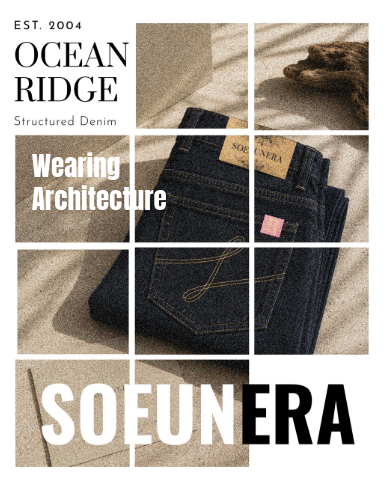
A building does not stand by accident. Every beam has a reason, and every opening is measured against the light. We believe a pair of jeans deserves the same attention: a quiet structure, designed to carry a body through a whole day, and then through a whole decade.
I — Composition
The Anatomy of a Silhouette
Every Soeunera jean begins with its material. We cut in organic cotton denim, with enough body to hold a line and enough softness to settle into the person wearing it. The weave is the foundation, and everything built on top of it depends on its integrity.
From there, the form is drawn in proportion. The rise decides where the jean sits and how the leg falls from it. The waistband anchors the whole piece, and the seams run where the body bends. The leg is cut either to gather in a clean straight line or to open into a generous, sweeping wide leg. Nothing here is decorative. Each element is present because the structure asks for it.
Honest weight
Organic cotton denim, chosen for its weight and for the way it ages.
Set with intent
High or mid, placed to draw the line from waist to hip.
Strong, not stiff
Reinforced where the body moves most, so strength never feels rigid.
Room to fall
Straight or wide, with space to drape rather than cling.
Good structure is invisible while you wear it, and unmistakable when you don't.
House of SoeuneraII — On the Body
How a Jean Should Fall
Ask anyone who has stood in a fitting room, pins in hand, and they will tell you the same thing: a jean is judged long before anyone looks at the label. The eye goes first to the waist. Does the rise sit where the body wants it? Does the waistband rest without gripping? On a good pair, the line from waist to hip is one unbroken gesture, and nothing pulls, gapes or argues with the figure.
Then the eye travels down. On a model in motion, a well-cut leg does not cling and does not flap. It falls. The cloth skims the thigh, releases at the knee and moves a fraction after the body does, as if the garment were thinking it over. That small delay is the whole secret. It is what makes a wide leg look weightless, and a straight leg look decided.
The hem is the final word. A line that lands cleanly at the shoe, with a soft break or none at all, tells the room that every proportion above it was considered. This is why we speak of architecture. A jean is not a shape applied to a body. It is a shape the body completes.
III — The Second Skin
Why Structure Feels Like Freedom
It is easy to assume that structure and comfort are opposites. We have found the reverse. A garment that is properly built does not need to be forced onto the body. It meets it. The weight sits where it should, the cloth moves with the stride rather than against it, and soon you stop noticing that you are wearing anything at all.
That is what we mean by a second skin. Not something tight, but something that belongs to you. Denim has a rare gift: it listens. Over weeks of wear it softens at the knee, relaxes at the waist and learns the way you stand. No two pairs end up alike, because no two people move alike. Every crease and soft fade becomes a record of your days, and no one else's.
IV — In Practice
Dressing in Quiet Confidence
When the structure is right, restraint becomes the whole point. The jean does the architectural work, and everything around it is free to be quiet. By day, a crisp white poplin and a single considered coat, and the cut does the speaking. By evening, silk against raw cotton, a narrow heel and a long jacket, with nothing to compete with the line of the leg.
In the atelier we say a garment is only finished once it is worn. Wear less, but wear it well, and let the form speak. To wear architecture is to carry something made with care, and to feel entirely at home inside it.